
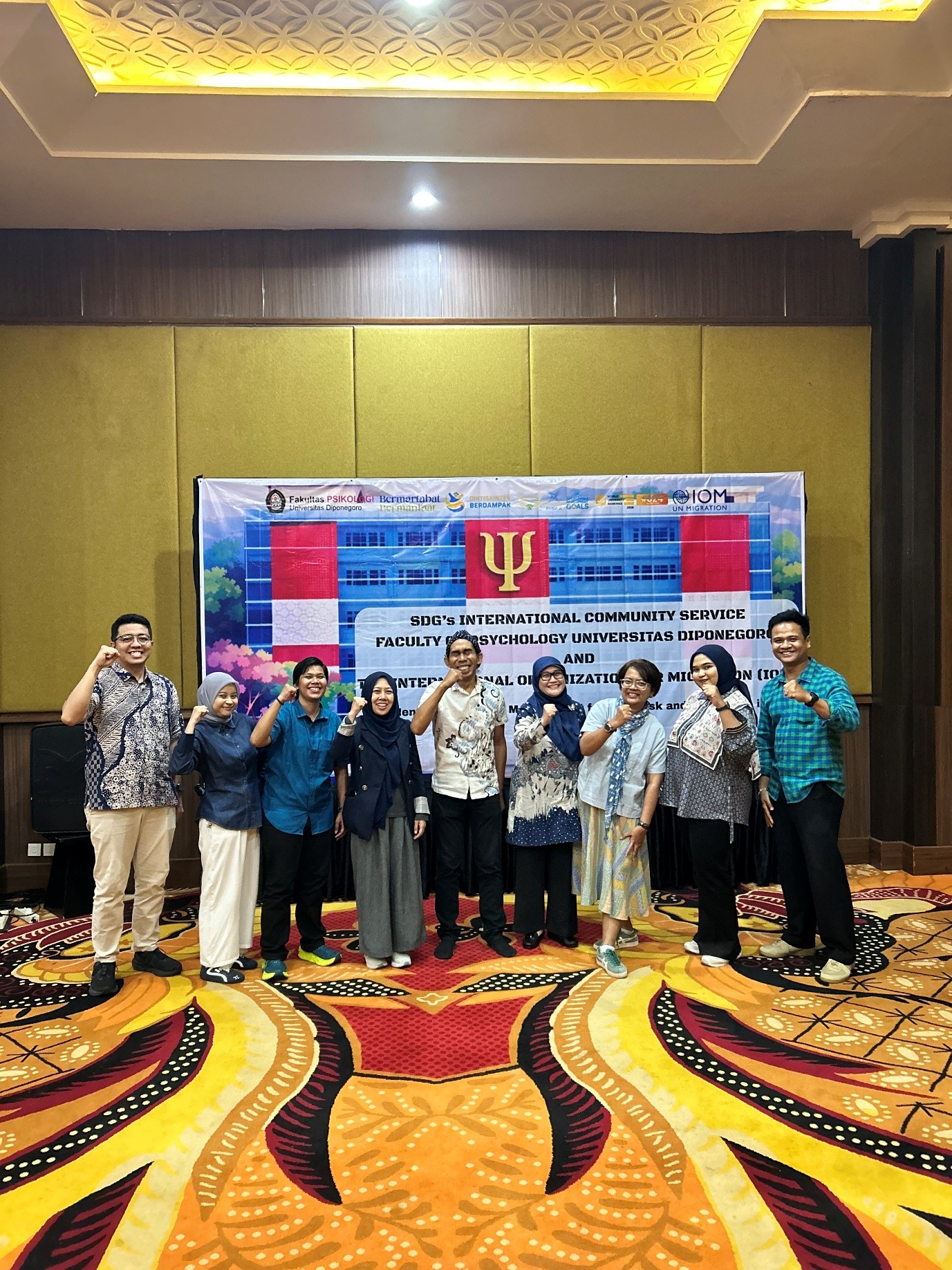
Yogyakarta – The Faculty of Psychology at Universitas Diponegoro, in collaboration with The International Organization for Migration (IOM), held the SDG’s International Community Service event with the theme “Mental Health Care Management for High-Risk and Vulnerable Groups in Humanitarian Settings” at The Alana Hotel and Conference Center Malioboro on April 16–18th, 2026. This activity was attended by 41 Care Management staff from IOM Indonesia originating from various regions, such as Tangerang, Medan, Batam, Jakarta, Kupang, and Makassar. The participants included both health and non-health personnel who directly handle refugees from various countries, including Afghanistan, Pakistan, Sudan, and other countries. The main goal of this activity is to support the vision and mission of Universitas Diponegoro as a world-class university by strengthening collaboration through the utilization of international networks as solutions to problems and challenges in society, involving the academic community of the Faculty of Psychology at Universitas Diponegoro and the academic community from abroad in the implementation of global activities beneficial to society. Another goal of this activity is to support the implementation of SDG activities, especially SDG 3 (Good Health and Well-Being), SDG 11 (Sustainable Cities and Communities), and SDG 17 (Partnership Strategy) for vulnerable groups (refugees).
On the first day, participants received material related to Responding to Self-Harm (NSSI) and Suicidal Disclosure presented by Dr. Lusi Nur Ardhiani, S.Psi., M.Psi., Psychologist, who emphasized the identification of NSSI and suicide attempts referring to DSM-5 TR, as well as Safety Planning and Risk Management by Dr. Kartika Sari Dewi, S.Psi., M.Psi., Psychologist, who emphasized systematic efforts to prevent, reduce, and respond to safety and mental health risks faced by refugees, especially in vulnerable humanitarian situations. In addition to the material presentation, the activities also included case studies discussed in groups, followed by presentations of group discussion results, and Q&A sessions to strengthen participants understanding and practical skills. In the final session, the facilitator helped participants explain how to fill out mental health instruments as an effort to screen the participants mental health.
Entering the second day, the event featured Ajeng Puspitasari, Ph.D., who joined online via Zoom meeting from the University of Wisconsin-Milwaukee, United States of America (USA), with moderator Arif Triman, S.Psi., M.Ed. The material presented included Counselling for High-Risk Cases in Humanitarian Settings as well as Referral Pathways and Coordination. This session emphasized the importance of counseling skills for high-risk cases and cross-health service coordination to ensure the continuity of psychosocial support for refugees.
On the third day, the activities concluded with a session featuring Yohanis Franz La Kahija, S.Psi., M.Sc., and Dr. Unika Prihatsanti, S.Psi., M.A., Psychologist. The material presented focused on Grounding and Calming Strategies (Relaxation). In this session, participants practiced various grounding and relaxation techniques as a way to help individuals manage stress, anxiety, and crisis situations. The entire series of activities was designed not only to strengthen conceptual understanding but also practical skills that can be directly applied in the field. Through this training, it is expected that participants will be able to enhance their capacity to provide more empathetic, structured, and sustainable mental health services for high-risk and vulnerable groups in humanitarian settings.

