- psikologi@live.undip.ac.id
- |
- 024 – 7460051

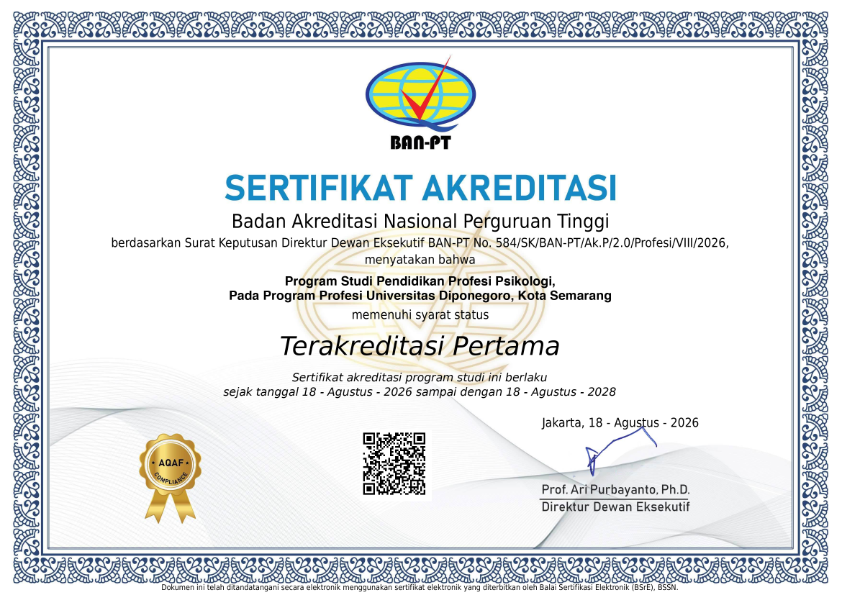
Psychologist Professional Education Study Program (Professional Program)
Vision
To become an outstanding institution providing Professional Psychology Education that prioritizes professionalism in delivering evidence-based psychological services.
Mission
- To provide an excellent professional psychology education program grounded in scientific knowledge and professional psychological ethics to produce graduates who are professional in carrying out promotive, preventive, and curative actions for individuals, groups, and/or communities through evidence-based psychological assessment and intervention.
- To collaborate with stakeholders at the national and international levels in developing innovations in psychological services to promote the mental well-being of society.
- To develop professional, competent, and accountable governance of the Professional Psychology Education Program.
Objectives
To prepare students to enter the professional world as general psychologists who are authorized to carry out promotive actions (strengthening, promoting, developing, building) to develop individual potential, as well as preventive and curative actions to address psychological problems and/or psychological disorders in daily life according to individual circumstances and to improve their own psychological well-being.
PSP5 Learning Outcomes
| No. | Learning Outcomes | Reference Source |
| I. | ATTITUDE ASPECT Competency 1: Ethics, Morality, Plurality, and Empathy Able to carry out professional psychological activities in accordance with psychological ethics and standards of practice, demonstrating empathy toward individuals, groups, and communities with diverse cultures, backgrounds, and characteristics reflected in their spiritual and social lives, whether interacting with service users, colleagues, or other professions. | DECREE-AP2TPI-SK-002/AP2TPI/SI/I/2024 concerning Curriculum Standards for the Professional Psychology Education Study Program |
| II. | KNOWLEDGE/SCIENTIFIC MASTERY ASPECT Competency 2: Psychological Concepts and Theories Possesses adequate knowledge and understanding of: 1. Human beings as individuals and as part of an ecological system; 2. The philosophy, concepts, theories, methods, and practices of psychology related to the functioning and changes in human behavior throughout the lifespan from biological, psychological, social, and spiritual perspectives, both general and specific. | DECREE-AP2TPI-SK-002/AP2TPI/SI/I/2024 concerning Curriculum Standards for the Professional Psychology Education Study Program |
| III. | GENERAL WORK SKILLS ASPECT Competency 3: General Skills 1. Able to work in the field of psychology and possess work competencies at least equivalent to the professional psychology occupational competency standards; 2. Able to make independent decisions in carrying out professional psychology work based on logical, critical, systematic, and creative thinking; 3. Able to document, store, audit, secure, and retrieve data and information for the purpose of developing professional psychology work outcomes; 4. Able to communicate ideas/arguments or innovative work that benefits professional development, which can be scientifically justified and ethically accountable, to the public, particularly the psychological professional community; 5. Able to critically evaluate work outcomes and decisions made in carrying out their duties, both by themselves and by colleagues; 6. Able to lead a team in solving problems in the field of professional psychology; 7. Able to collaborate with other professionals in related fields to solve problems in professional psychology work; 8. Able to develop and maintain professional networks with the psychological professional community and service users; 9. Accountable for work in their professional field in accordance with the psychological code of ethics; 10. Able to independently enhance their learning capacity; 11. Able to contribute to the evaluation or development of national policies aimed at improving the quality of professional psychology education or developing national policies in the field of professional psychology; 12. Able to identify personal strengths and weaknesses (self-evaluation) and remain open to feedback regarding personal development. | DECREE-AP2TPI-SK-002/AP2TPI/SI/I/2024 concerning Curriculum Standards for the Professional Psychology Education Study Program |
| IV. | SPECIFIC SKILLS ASPECT Competency 4: Communication Skills Able to establish good rapport and professional work communication with: 1. service users; 2. significant others of service users; 3. related professions; 4. supervisors. Competency 5: Psychological Assessment Skills Able to conduct assessments and diagnose psychological problems in individuals, groups, organizations, and/or communities in healthcare, education, workplace, and community service settings based on the psychological code of ethics and empirical evidence, which includes: 1. Able to establish assessment objectives; 2. Able to identify problems/needs; 3. Determine assessment methods encompassing observation, interviews, psychological tests, and other methods, based on consideration of the advantages and limitations of those assessment methods; 4. Conduct administration, scoring, and interpretation in assessments; 5. Able to integrate assessment data as a basis for developing psychological dynamics; 6. Draw conclusions or establish diagnoses based on assessment results and psychological theories; Competency 6: Psychological Intervention Skills Able to demonstrate knowledge and skills in intervention techniques based on the psychological code of ethics and empirical evidence, encompassing: 1. PLANNING i. Able to establish intervention objectives and techniques at the preventive, promotive, and curative stages, including the ability to justify the relationship between the diagnosis and the selected intervention, based on psychological theories; ii. Able to plan preventive, promotive, and curative interventions to achieve outcomes in accordance with the examination objectives, based on knowledge of psychological intervention approaches, models, and techniques, taking into consideration the advantages and disadvantages of the proposed design. 2. IMPLEMENTATION i. Able to implement psychological interventions at the preventive, promotive, and curative stages; ii. Provide implementation guidelines to relevant parties (those with an interest in the service user, for example: parents, teachers, superiors, management, etc.) that support the implementation of psychological interventions; iii. Able to apply several types of interventions such as Psychological First Aid (PFA), psychological consultation, psychoeducation, counseling, psychological training, and psychotherapy (such as behavior modification) to change behavior in individuals, groups, organizations, and/or communities in healthcare, education, workplace, and community service settings; iv. Able to integrate implementation methods that constitute the strengths (distinctive characteristics) of their respective study programs. 3. EVALUATION Able to evaluate intervention effectiveness by: i. Evaluating the intervention process; ii. Evaluating service users’ responses to the intervention; iii. Measuring changes in attitudes and behavior; iv. Revising problem formulations and intervention program designs, if necessary; v. Able to integrate evaluation methods that constitute the strengths (distinctive characteristics) of their respective study programs. Competency 7: Ability to Communicate the Results of Psychological Assessment and Intervention Able to communicate the results of psychological assessment and intervention orally and in writing in an informative, accurate, clear, systematic manner, and in accordance with the characteristics and needs of service users. Competency 8: Psychological Ethics and Law 1. Understand the Indonesian Psychological Code of Ethics and be able to apply it in solving psychological problems; 2. Be aware of the rights and scope of authority of their competencies, and not work beyond those rights and authority; 3. Able to be accountable for work processes and outcomes based on the Indonesian Psychological Code of Ethics; 4. Possess knowledge of applicable laws in providing psychological services, specifically those related to psychological problems associated with the law. | AP2TPI DECISION SK-002/AP2TPI/SI/I/2024 Concerning Curriculum Standards for the Psychology Professional Education Study Program |
PSP5 Competency Map
| Aspect | Competency | Courses |
| Attitude | Ethics, Morality, Plurality, and Empathy | Professional Psychology Code of Ethics |
| Knowledge/Scientific Mastery | Psychological Concepts and Theories | 1. Professional Psychology Assessment Theory and Practicum 2. Professional Psychology Intervention Theory and Practicum |
| General Work Skills | General Skills | 1. Professional Psychology Assessment Theory and Practicum 2. Professional Psychology Intervention Theory and Practicum 3. Professional Psychology Code of Ethics 4. Psychological Report Writing |
| Specific Work Skills | Communication Skills | 1. Professional Psychology Assessment Theory and Practicum 2. Professional Psychology Intervention Theory and Practicum 3. Professional Psychology Code of Ethics 4. Psychological Report Writing |
| Specific Work Skills | Psychological Assessment Skills | 1. Professional Psychology Assessment Theory and Practicum 2. LPPU in Healthcare Settings 3. LPPU in Educational Settings 4. LPPU in Workplace Settings 5. LPPU in Community Settings |
| Specific Work Skills | Psychological Intervention Skills | 1. Professional Psychology Intervention Theory and Practicum 2. LPPU in Healthcare Settings 3. LPPU in Educational Settings 4. LPPU in Workplace Settings 5. LPPU in Community Settings |
| Specific Work Skills | Ability to Communicate Psychological Assessment and Intervention Results | 1. Psychological Report Writing 2. LPPU in Healthcare Settings 3. LPPU in Educational Settings 4. LPPU in Workplace Settings 5. LPPU in Community Settings |
| Specific Work Skills | Self-Development | 1. LPPU in Healthcare Settings 2. LPPU in Educational Settings 3. LPPU in Workplace Settings 4. LPPU in Community Settings |
| Specific Work Skills | Psychological Ethics and Law | Professional Psychology Code of Ethics |
Certification
Faculty of Psychology UNDIP
-
Jalan Prof. Mr. Sunario Tembalang, Semarang, 50275
Mail : psikologi@live.undip.ac.id
Phone : (024) 7460051 | Fax : 76405530
-
Jalan Prof. Mr. Sunario Tembalang, Semarang, 50275
Mail : psikologi@live.undip.ac.id
Phone : (024) 7460051 | Fax : 76405530
Other Information
- E-Learning
- PPID
- Portal Dosen/Mahasiswa
- helpIT
- Integrity Zone

- SDG's
- ULT
- Training Center
- Food Truck
- Campuss Bus
